
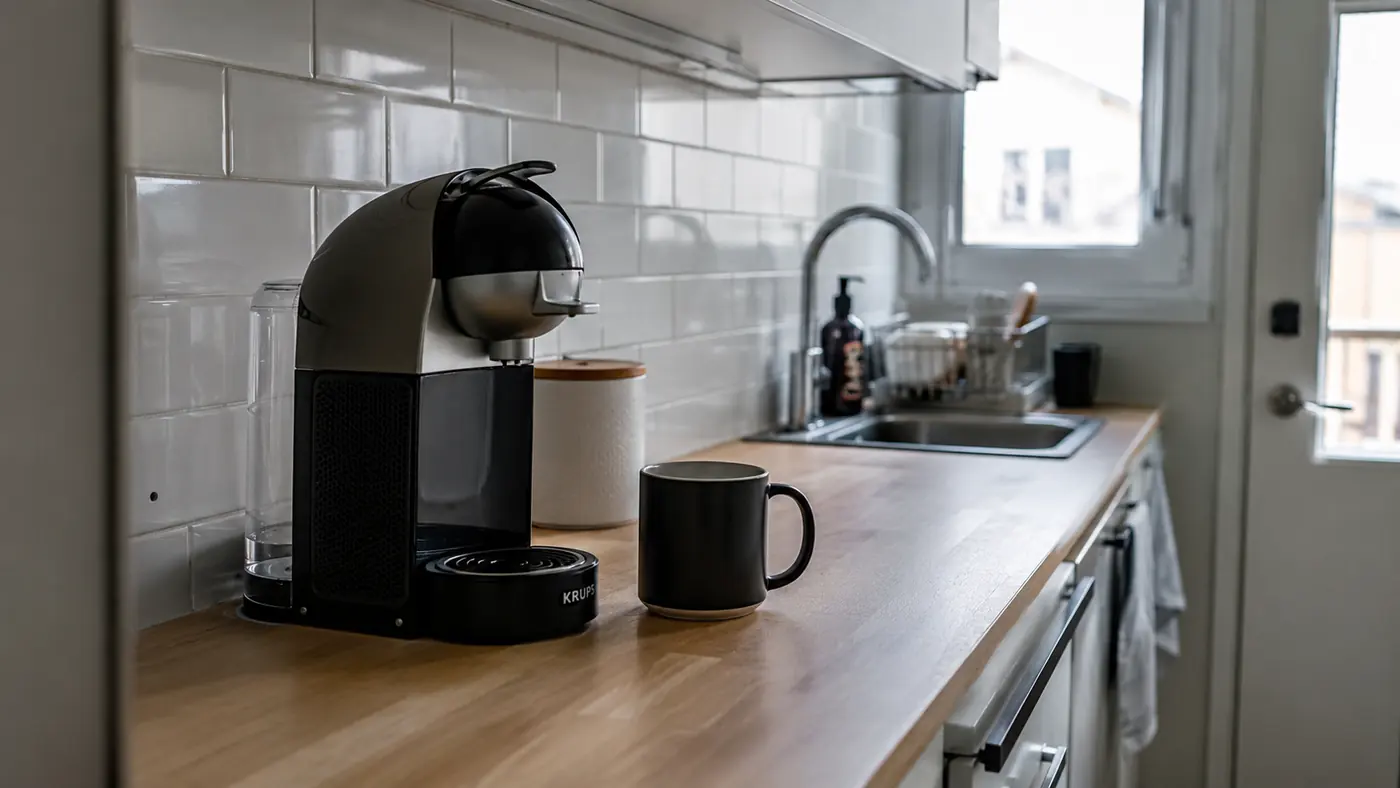
Nobody tells you how often you'll actually be refilling the water on the Keurig K-Mini Mate until you own one. I bought it for my kitchen, which is a narrow galley with about three feet of usable counter and two outlets that both sit behind my dish rack, because I wanted something small enough to leave out permanently without crowding my one cutting board. What I got was exactly as small as advertised. What I didn't get, and what the listing photos don't really prepare you for, is a coffee maker that holds noticeably less water than it looks like it should, brews louder than I expected from something this size, and does a much narrower set of things than the word Keurig usually implies.
This isn't a review written after one good cup on day one. This is the version where I tell you what surprised me, what annoyed me, and what I wish someone had said before I set it up next to my stove. If you're deciding between this and a full-size Keurig, or between this and the drip machine currently taking up more counter than you can spare, I want you to know exactly what you're signing up for.
The Quick Verdict
Genuinely small and genuinely simple, but the reservoir math, the noise, and the mug height limit are bigger adjustments than the marketing photos suggest.
Amazon Check Today's Price →Before You Buy It, Know What the Reservoir Actually Holds
If counter space is your real constraint, the K-Mini Mate earns its footprint, but you should know the tradeoffs going in rather than finding them out at 6 a.m. on a Tuesday.
Amazon Check Today's Price on Amazon →How I've Actually Used It
My routine is simple and I suspect it's close to how most people in a small kitchen actually use one of these. I make one cup in the morning, sometimes a second cup around 2 p.m. when I'm working from the couch, and Danny makes his own cup separately most mornings because we don't drink the same roast. That's it. No carafe, no batch brewing, no fancy espresso attempts. The Keurig K-Mini Mate was built for exactly this kind of single-person, single-cup pattern, and on that narrow use case it does the job without complaint.
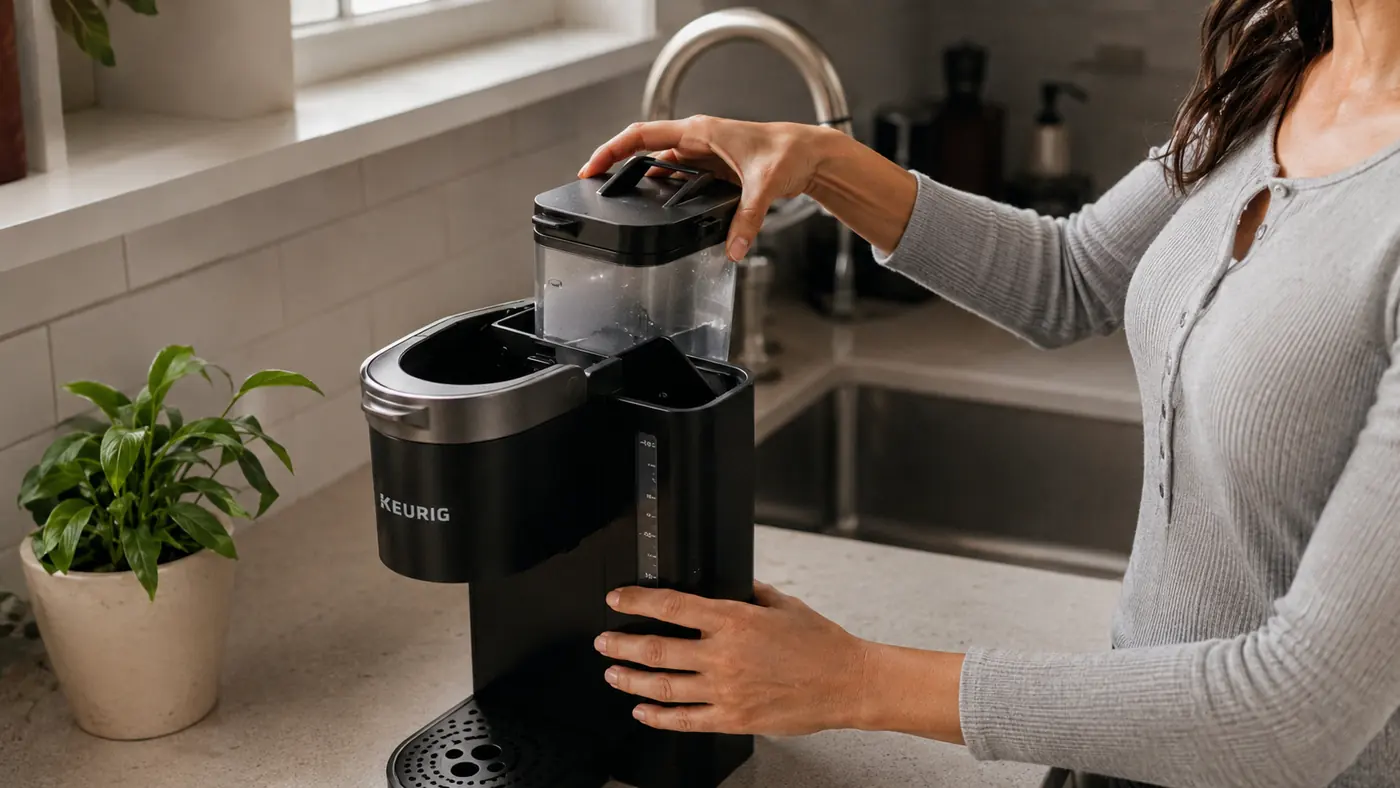
Where it started to bother me wasn't the brewing itself, it was the rhythm around it. The detachable storage cup on top, the part Keurig calls the "Mate," holds extra water so you don't have to refill before every single cup, and that's a genuinely smart design touch for a machine this size. But it's not a large reservoir by any stretch, and the first week I owned it I underestimated how often I'd be walking it over to the sink. I want to get specific about that before you buy one, because the actual number surprised me.
I'll admit the first few days I judged it against the box photos more than against my own kitchen, which is a mistake I'd tell anyone to skip. The images show the machine sitting pristine on an open counter with nothing around it. My counter has a knife block, a dish rack, and a spice shelf crowding it on both sides, so the real test wasn't whether it looked nice, it was whether it fit into a kitchen that already had things in it. It did, easily, which is honestly the one part of the marketing that held up exactly as promised.
For comparison, if you're trying to decide between this and something with a bigger water tank and a bigger footprint, I put together a closer side-by-side in Keurig K-Mini Mate vs. Nespresso Vertuo that gets into reservoir size and brew style specifically. That's worth reading before you commit if capacity is a concern for your household.
The Reservoir Reality Nobody Mentions
Here's the part I want to be blunt about. The K-Mini Mate's onboard reservoir holds enough water for roughly one brew at a time when you're using it in its compact configuration, and the detachable storage cup on top adds a bit of a buffer, but even with both in play I'm refilling at the sink most days, sometimes twice if Danny and I are both making a cup within the same half hour. If you're picturing something you fill on Sunday and forget about until Wednesday the way you might with a full-size drip machine, that's not this appliance. It's built to be small, and small means the water has to come from somewhere close by, often.
This isn't a defect, it's a direct tradeoff for the footprint, and it's the single biggest adjustment I had to make in the first two weeks. Once I accepted that this Keurig lives right next to my sink rather than tucked into a corner, the refilling stopped feeling like a chore and started feeling like part of the routine, the same way I don't think twice about filling a kettle. But if your kitchen setup means the sink is across the room from wherever your outlets are, factor that walk into your daily math before you buy, because you'll be making that trip more than the box photos suggest.
The other thing nobody mentions is that the reservoir is genuinely tiny to look at in person. In photos it reads as a normal-sized water tank. In my kitchen, sitting next to a regular coffee mug, it looks almost comically small, which is honestly reassuring once you know what to expect. It's proof the footprint claims are accurate. Just don't expect it to behave like a bigger machine.
How Loud It Actually Is
I did not expect this to be a talking point when I bought it, but it's become one of the things I mention most when people ask about the Keurig K-Mini Mate. It's not obnoxiously loud, but it's not the quiet little hum you might assume from something this compact. There's a distinct pumping and gurgling sound while it brews, more mechanical than I anticipated, and in a 500-square-foot apartment where the kitchen is basically open to the living room, it's audible enough that it's woken Danny up on mornings I've tried to sneak a cup before he's up.
It's not louder than a typical drip machine grinding through a brew cycle, to be fair, and it only runs for under a minute per cup, so it's not a sustained noise problem the way a blender is. But if you're in a studio apartment, a dorm with a sleeping roommate, or anywhere with thin walls and early mornings, I'd factor this in. It's not a dealbreaker for me, but it would have changed how I planned my morning routine if I'd known ahead of time.
The sound itself is short, a rising gurgle followed by the actual pour, then it clicks off. Once you know the pattern it stops being surprising. It's just not the near-silent experience the compact size might lead you to expect, and that gap between expectation and reality is exactly the kind of thing I wish the listing had mentioned.

Cleaning and Descaling, the Unfiltered Version
This is the maintenance conversation that almost never makes it into a first-impressions review, and it matters more than people think. The Keurig K-Mini Mate needs regular descaling, not optional, not occasional, actually necessary if you want it brewing at full strength and temperature. Our apartment has moderately hard tap water, and I started noticing slower brew cycles and a slightly weaker pour by around the two-month mark. That's earlier than I expected for a machine I use once or twice a day.
Descaling itself isn't complicated. It's a solution run through an empty brew cycle a few times, followed by a few cycles of plain water to rinse it out, and it takes maybe twenty minutes total including the waiting. But it's a task you have to remember to do, and it's easy to forget when the machine is small enough that you stop thinking of it as needing upkeep the way you would a bigger appliance. I've now got a reminder set on my phone, which tells you how easily I let it slide the first time.
Day-to-day cleaning is genuinely simple, a quick wipe of the drip tray and the exit needle area with a damp cloth, and there's not much surface for grime to collect on given how compact the whole unit is. It's the descaling that's the real maintenance item here, and it's the part I'd flag hardest for anyone assuming a machine this small must also be maintenance-free. It isn't.
The Drip Tray and Mug Height Trade-off
This is the one that genuinely caught me off guard the first week, and I haven't seen it mentioned in most listings. The drip tray sits fairly high by default, which means a standard mug fits fine, but the travel mug I actually wanted to use most mornings, the one I take to my desk, does not clear it. You have to physically remove the drip tray to fit a taller mug or a travel tumbler underneath the spout, which solves the height problem but trades it for a different one.
Once that tray is off, any small drip or overflow lands directly on the counter instead of being caught, and on a counter with three feet of usable space that's already doing double duty as prep area, that's not nothing. I've adjusted by keeping a folded dish towel underneath whenever I brew into the travel mug, which works fine but is exactly the kind of workaround the product page never mentions. If you're someone who mostly uses a tall tumbler, budget for this adjustment before you assume it'll just slide underneath.
What It Genuinely Cannot Do
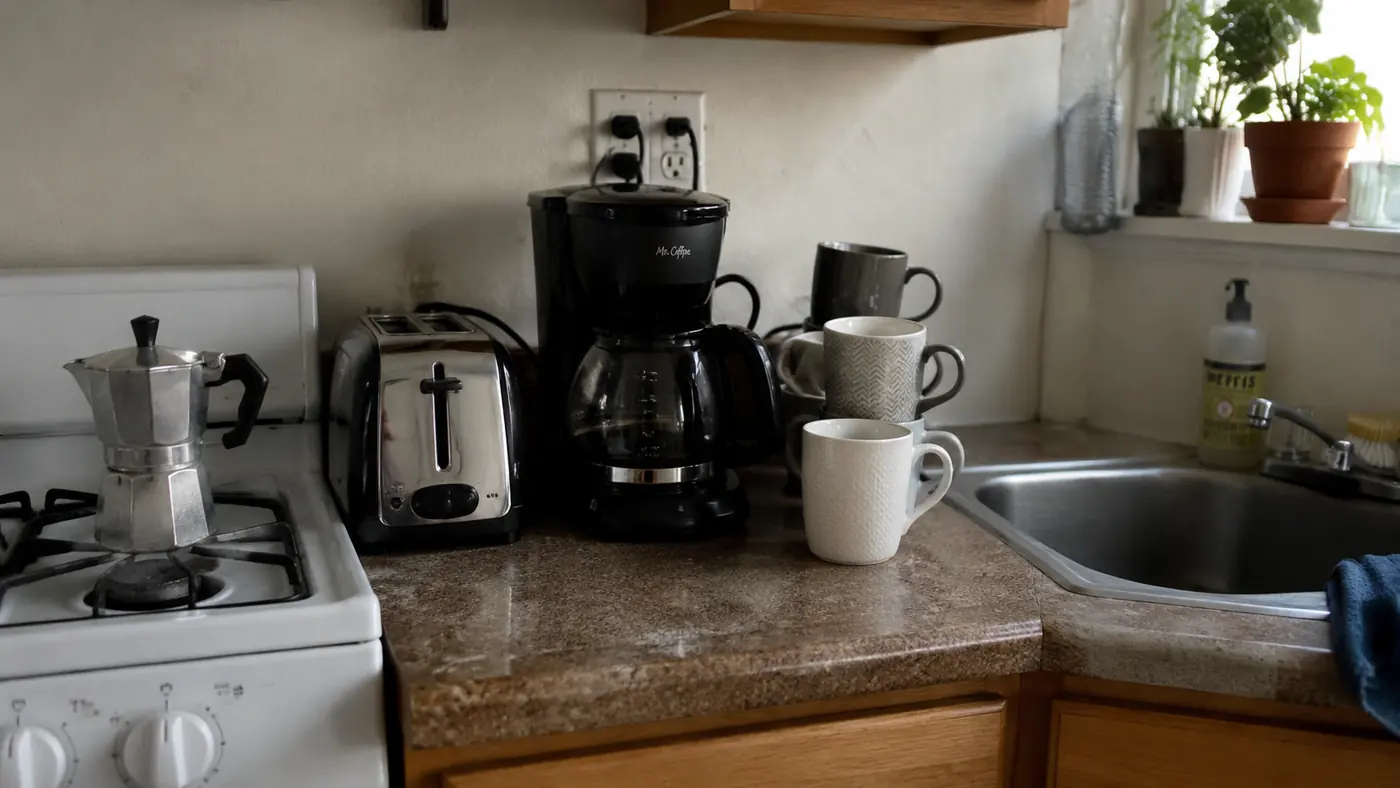
I want to be direct about the limitations, because a lot of reviews gloss over them. There's no cup-size selection on the K-Mini Mate the way there is on bigger Keurig models. You get one brew size per cycle, controlled loosely by how long you hold the button down, and it takes a few tries to dial in a pour that matches your actual mug rather than overflowing it or leaving you short. I ruined more than one cup in the first week figuring out the timing, and it's not something the manual explains particularly well.
There's also no strength adjustment, no iced setting, and no hot water dispense without running a pod through it, so if you were picturing a small appliance you could also use to quickly heat water for tea or instant oatmeal, that's not what this is. Every cycle requires a K-Cup pod, full stop. If your household mixes coffee drinkers with tea drinkers or people who just want hot water on demand, this alone might be enough to steer you toward a different appliance, or toward keeping a kettle around too.
And because it only takes standard K-Cup pods, you're committed to that format going forward. There's no reusable filter basket option built in the way some competing single-serve machines offer, and no way to brew loose grounds. If you already drink K-Cup coffee and just needed something smaller, none of this matters. If you were hoping this Keurig would replace a full coffee setup and flex into other uses, it won't, and that's the honest limitation worth knowing before you buy.
What I Liked
- Genuinely tiny footprint, the smallest coffee maker I've owned that still felt like a real appliance
- Brews in under a minute once the reservoir has water in it
- Simple one-button operation with nothing to program or sync
- Detachable storage cup on top adds a modest buffer between refills
- Cleanup is quick since there's so little surface area to wipe down
Where It Falls Short
- Reservoir is smaller in real use than the photos suggest, expect frequent refills
- Louder brew cycle than the compact size implies, noticeable in an open studio layout
- No cup-size selection, brew volume is controlled loosely by how long you hold the button
- Requires regular descaling sooner than I expected with moderately hard tap water
- Drip tray has to come off to fit a taller travel mug, which risks counter drips
- No hot water dispense or strength control, every cycle needs a K-Cup pod
The K-Mini Mate is exactly as small as it claims to be. What the listing photos don't show you is how often you'll be walking that reservoir back to the sink.
Who This Is For
This has been the right coffee maker for a genuinely tight kitchen where every inch of counter and every outlet is already spoken for. If you're making one or two cups a day, you already drink K-Cup pods or don't mind switching to them, and your kitchen is close enough to a sink that a refill isn't a production, the Keurig K-Mini Mate delivers on the one thing it promises: it takes up almost no space and it works without any learning curve beyond figuring out your pour timing and the drip tray swap for taller mugs.
Who Should Skip It
If you're a household of three or more coffee drinkers, or you want cup-size flexibility, or you were hoping to also use it for hot water and tea, skip this one and look at a slightly larger single-serve machine with an actual water tank and multiple brew sizes. I'd also skip it if noise sensitivity is a real concern in your space, a shared studio, a dorm with a sleeping roommate, or a bedroom right off the kitchen. If you exclusively drink out of a tall travel tumbler and don't want to deal with removing the drip tray every morning, that's also worth weighing. The footprint is the entire selling point here, and if that's not your binding constraint, you'll likely get more convenience from a bigger machine.
Still Worth It If Space Is Your Real Constraint
Knowing the reservoir, the noise, and the descaling reality upfront, this has still earned its spot on my counter for the one thing it's actually built to do.
Amazon Check Today's Price on Amazon →