Nobody sent me this one either. I bought the DASH Mini Toaster Oven with my own money last spring after my ancient two-slice toaster finally gave out, and I want to tell you what actually happens once it's living on your counter, not what the listing photos suggest. My kitchen is a narrow galley with about three feet of usable counter between the stove and the fridge, two outlets total, and one of them already runs my kettle most mornings. That's the lens this review comes through.
The short version is that the DASH Mini Toaster Oven is a genuinely useful small appliance with a handful of real quirks that nobody mentions before you buy it. The interior is smaller than the marketing shots make it look, there's a hot spot in the back corner that took me almost three weeks to actually notice, the timer doesn't ding loud enough to hear from the next room, and the outside gets legitimately warm to the touch while it's running. None of that makes it a bad toaster oven. It just means you should know its real shape before you clear counter space for it.
I've bought and returned more small kitchen gadgets than I'd like to admit over twelve years of apartment cooking, so this review is written the way I wish reviews had been written for me before my last few toaster-oven-shaped disappointments: what surprised me, what mildly annoyed me, and what I'd tell a friend honestly before she hits the buy button, not after she's already rearranged her counter around it.
What Actually Fits Inside
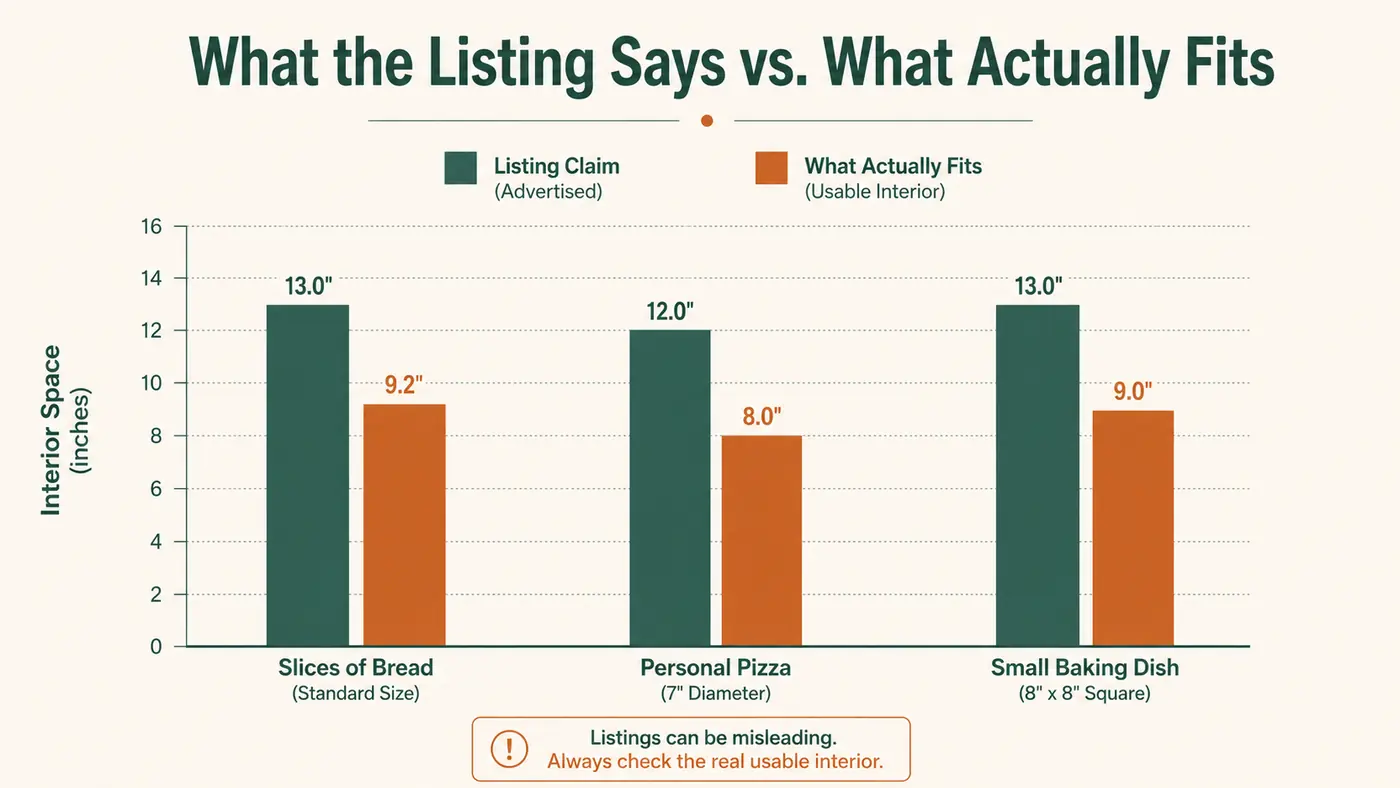
DASH markets this as a good fit for personal-size toasting and baking, and technically that's true, but the real interior dimensions surprised me the first week. Two slices of standard sandwich bread fit side by side with almost no room to spare between them, and if you're using a thicker artisan loaf, you're toasting one slice at a time instead of two. A frozen personal pizza fits, but only if it's genuinely personal-size, the kind sold in a six-inch round. I tried a slightly larger flatbread pizza my first week and had to trim the edges with kitchen shears to get the door to latch.
Height is the constraint that surprised me most, more than width or depth. A standard coffee mug for baking eggs does not clear the top rack with room to spare, and a typical 8x8 baking dish will not fit at all, not even close. A smaller 6x6 dish clears it, barely, which is fine for reheating a portion of casserole but not for baking anything meant to serve more than one or two people. If you're picturing this as a scaled-down version of a full-size oven that just happens to sit on your counter, recalibrate that expectation before you buy, because the DASH is closer in spirit to a glorified toaster than a mini oven in the way it handles taller cookware.
For reference, I borrowed my mother-in-law's full-size countertop toaster oven for a weekend to compare side by side, and the difference in usable interior volume is not subtle. Her unit fits four slices of bread and a real baking sheet. Mine tops out around two slices and a personal-size tray before things start touching the heating elements. That's the actual comparison I wish had been on the listing instead of just a general capacity claim, because a cubic-inch number doesn't tell you anything about whether your actual dinnerware fits, and dinnerware fit is what determines whether you use the thing daily or shove it in a cabinet.
The Quick Verdict
A genuinely useful compact toaster oven for one or two people in a tight kitchen, with a smaller real-world interior, a noticeable hot spot, and a few daily habits nobody warns you about before you buy.
Amazon Check Today's Price →See Today's Price and Real Buyer Photos Before You Decide
The listing photos make the interior look roomier than it is. Check current pricing and scroll the buyer-submitted photos on Amazon to get a more honest sense of scale before you commit counter space to it.
Amazon Check Today's Price on Amazon →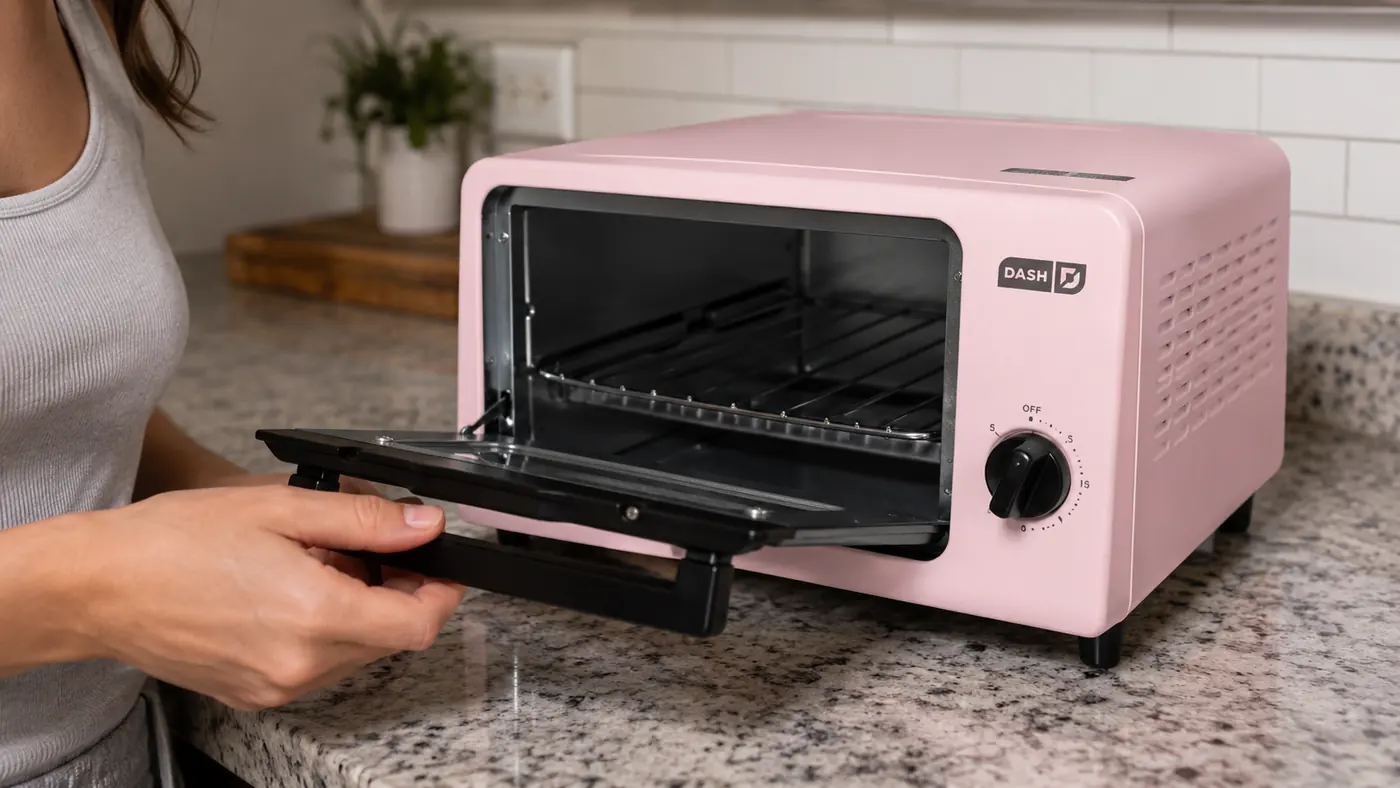
How I've Actually Used It
I run the DASH Mini Toaster Oven almost every morning for toast or a toasted English muffin, and it's become my go-to for reheating leftover pizza, which comes out with an actually crisp crust instead of the rubbery microwave version. On weeknights it handles small trays of vegetables, a single chicken thigh, or a sweet potato while I'm doing something else in the kitchen. The dial controls are basic, a temperature dial and a timer dial with a toast-shade selector, no touchscreen, no app, which is part of why it's stayed on my counter instead of getting rotated to a shelf like some of my other gadgets.
What surprised me is how much I use it as a toaster first and an oven second, even though I bought it thinking I'd mostly bake with it. The toast function is genuinely good, evenly browned most of the time, and it's replaced my old pop-up toaster entirely. The oven function I reach for maybe three times a week, mostly for reheating and small roasting jobs rather than anything from scratch, because the interior constraints described above make from-scratch baking feel like more effort than it's worth for anything beyond a single portion.
The one thing that took adjustment was accepting that this isn't a replacement for a full oven the way I initially hoped. It's a replacement for a toaster plus a reheating tool, and once I reframed it that way in my own head, my satisfaction with the DASH went up noticeably. If you're weighing it against a bigger countertop model, I compare footprint and capacity in more detail in Dash vs. BLACK+DECKER for anyone trying to decide between the two before buying.
The Hot Spot Nobody Warns You About
About three weeks in, I noticed my toast was coming out darker on the back-left corner than everywhere else, consistently, on every batch, regardless of how I loaded the rack. I tested it with a cheap oven thermometer I already had for my stove, moving it to different spots on the rack across several runs, and the back-left corner ran noticeably hotter than the front-right, enough that toast there was visibly a shade darker most mornings. It's not dramatic, and it's not unsafe, but it's real, and nobody mentions it in the marketing copy or the manual.
The fix has been simple once I figured it out: I rotate whatever I'm cooking roughly halfway through, the same habit you'd use in a full-size oven with an uneven element. For toast, that means flipping the slices if I notice uneven color building. For a small tray of vegetables, a quick shake or turn at the halfway mark solves it. It's a minor habit to build, but it would have saved me a few unevenly browned batches in the first month if I'd known to expect it going in.
The Timer, and the Beep You Can't Hear From the Living Room
The timer is a manual dial, up to thirty minutes, and it does shut the unit off and sound a beep when it hits zero, which is the important safety behavior. What nobody tells you is how quiet that beep actually is. My apartment is small, but the kitchen and living room share airflow, and if the TV is on or I'm running the sink, I've genuinely missed the end-of-cycle beep more than once and come back to toast a shade darker than I wanted rather than burnt, thankfully, but darker than intended.
There's no auto shutoff beyond the timer reaching zero, and there's no separate alarm or app notification, which makes sense for a unit this simple but is worth knowing if you're the type who wanders off to fold laundry while something toasts. My workaround has been setting a phone timer as backup for anything longer than a few minutes, which defeats some of the convenience but has kept me from a couple of near-misses since I started doing it consistently.
How Hot the Outside Gets While It's Running
This is the thing I wish someone had told me before I positioned it on my counter the first time. The exterior, particularly the top and the area right around the door handle, gets legitimately warm to the touch during a longer cycle, not scalding, but warm enough that I don't set anything directly on top of it while it's running, and warm enough that I keep it a few inches clear of my paper towel holder after nearly singeing a corner of a paper towel roll that was leaning against the side.
In my kitchen that meant rearranging things slightly. I moved a small basket of produce that used to sit right next to my old toaster to the other side of the counter, and I keep the DASH a solid four inches from the wall behind it rather than pushed flush, both for airflow and because the back panel runs warm too. If your counter setup is genuinely tight with things crowded close together, budget a little breathing room around this one specifically, more than you'd think a countertop appliance this size would need.
The Crumb Tray, Realistically
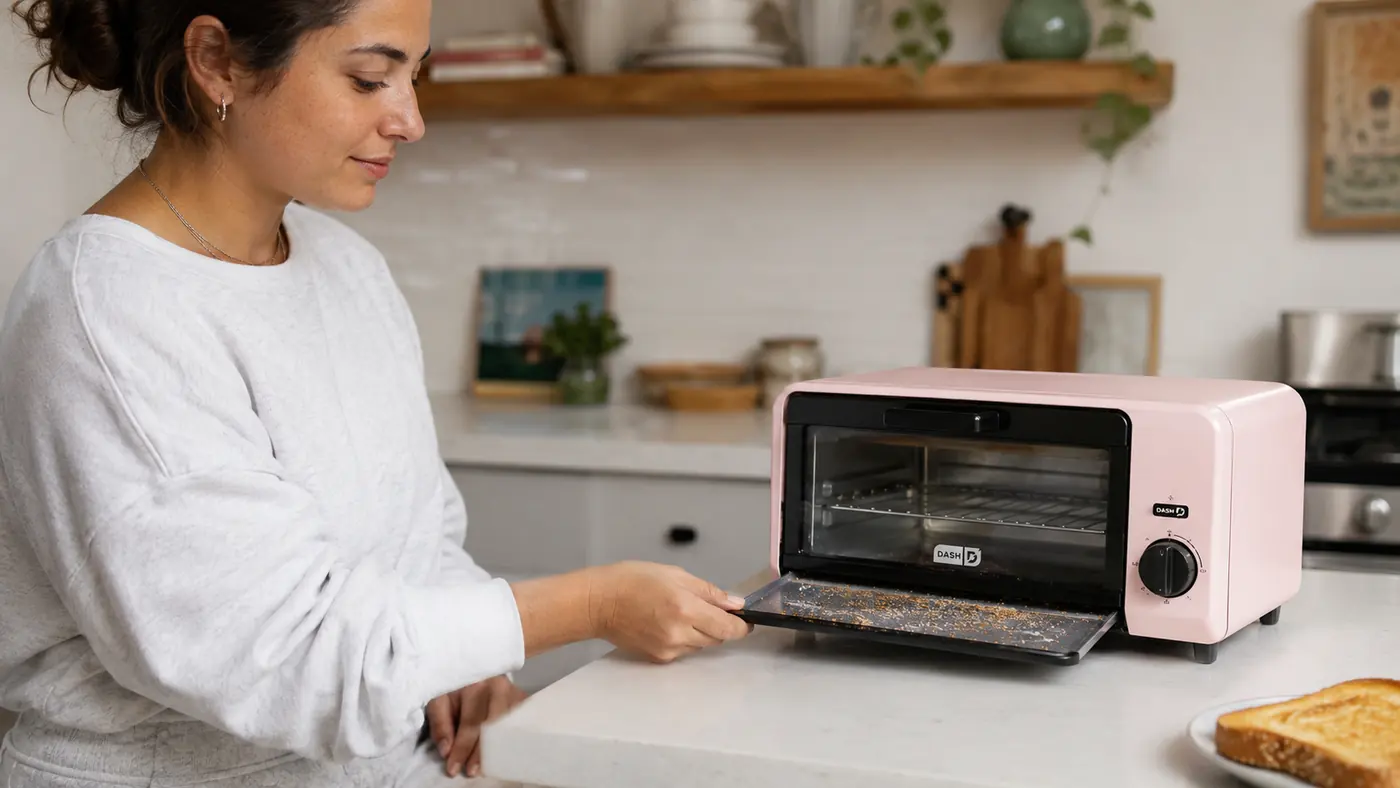
The crumb tray slides out from the bottom front, which is convenient, but it fills up faster than I expected given how small the interior is. Toasting two slices of bread daily means I'm emptying it every three or four days if I want to avoid a burning smell on the next cycle, not weekly the way I initially assumed. Anything with cheese or sauce that drips, like reheated pizza, leaves a light greasy residue on the tray that a dry shake doesn't fully clear, so it needs an actual wipe with a damp cloth every week or two on top of the crumb dumping.
It's not a hassle exactly, it's genuinely a thirty-second task once the tray is out, but it's more frequent upkeep than I expected from something this compact, and it's the kind of small maintenance detail that determines whether an appliance stays pleasant to own or starts to feel like a chore. I keep a small brush near the outlet specifically for this now, which has made the habit stick better than it did the first month when I kept putting it off.
What I Liked
- Toast function is genuinely even and reliable once you learn to rotate for the hot spot
- Beats the microwave for reheating pizza and other crisp-crust leftovers
- Small enough footprint to live permanently on a narrow counter
- Simple dial controls with no app or touchscreen required
- Crumb tray is easy to access even though it fills faster than expected
- Two-minute setup with no manual or firmware step to fuss with
Where It Falls Short
- Real usable interior is smaller than the listing photos suggest, especially in height
- Back-left corner runs noticeably hotter, requiring a mid-cycle rotation habit
- End-of-cycle beep is quiet enough to miss from another room
- Exterior runs warm enough that nearby items need a few inches of clearance
- Crumb tray needs emptying every few days with regular toast use
- Not a realistic substitute for a full oven for anything beyond single portions
The listing photos make the interior look roomier than it is. That gap between the marketing and the real usable space is the single biggest thing I wish I'd known going in.
What Genuinely Doesn't Fit
I want to be direct about the limits instead of hand-waving them. A standard 8x8 baking dish does not fit. A full sheet of cookies does not fit, only a small personal-size tray does. A whole chicken, a rack of ribs, or anything meant to feed more than one or two people at once is not what this appliance is built for, and trying to force it will mean multiple rounds, which gets old fast on a weeknight. There's no rotisserie, no air-fry setting, and no convection fan, just standard top-and-bottom heating elements in a small chamber.
What it does well is the narrow lane it was actually built for: toast, reheating, and small single-portion cooking in a footprint that genuinely fits a tight kitchen. If you're weighing it against a bigger countertop toaster oven, I put together a closer side-by-side at Dash vs. BLACK+DECKER that covers where the extra size of a full-size unit actually earns its keep versus where it's just extra counter you don't have to spare.
Who This Is For
This is the right toaster oven for one or two people in an apartment, dorm, or RV who mostly want great toast, quick reheating, and the occasional single-portion bake without giving up a foot of counter space to something the size of a real oven. If your actual daily use is toast, English muffins, reheated leftovers, and small trays, the real capacity here lines up fine with your needs, and the compact footprint is a genuine advantage rather than a compromise you're settling for.
Who Should Skip It
Skip it if you're regularly cooking for three or more people and want to bake or reheat a full meal in one pass. Skip it if you need a standard baking dish to fit without trimming your expectations down to personal-size cookware. And skip it if you tend to walk away from things cooking, since the quiet end-of-cycle beep and the lack of any secondary alert make it easy to lose track of a cycle if you're not paying attention. For a bigger household or anyone who bakes regularly, a full-size countertop oven is going to save real frustration, even though it costs more counter space, and that's a tradeoff worth being honest with yourself about before you buy.
Still Sound Like a Fit? Here's Where to Check It Out
If your kitchen and your portion sizes match what's described above, the DASH Mini Toaster Oven is worth a look. Check today's price and current availability before deciding.
Amazon Check Today's Price on Amazon →