
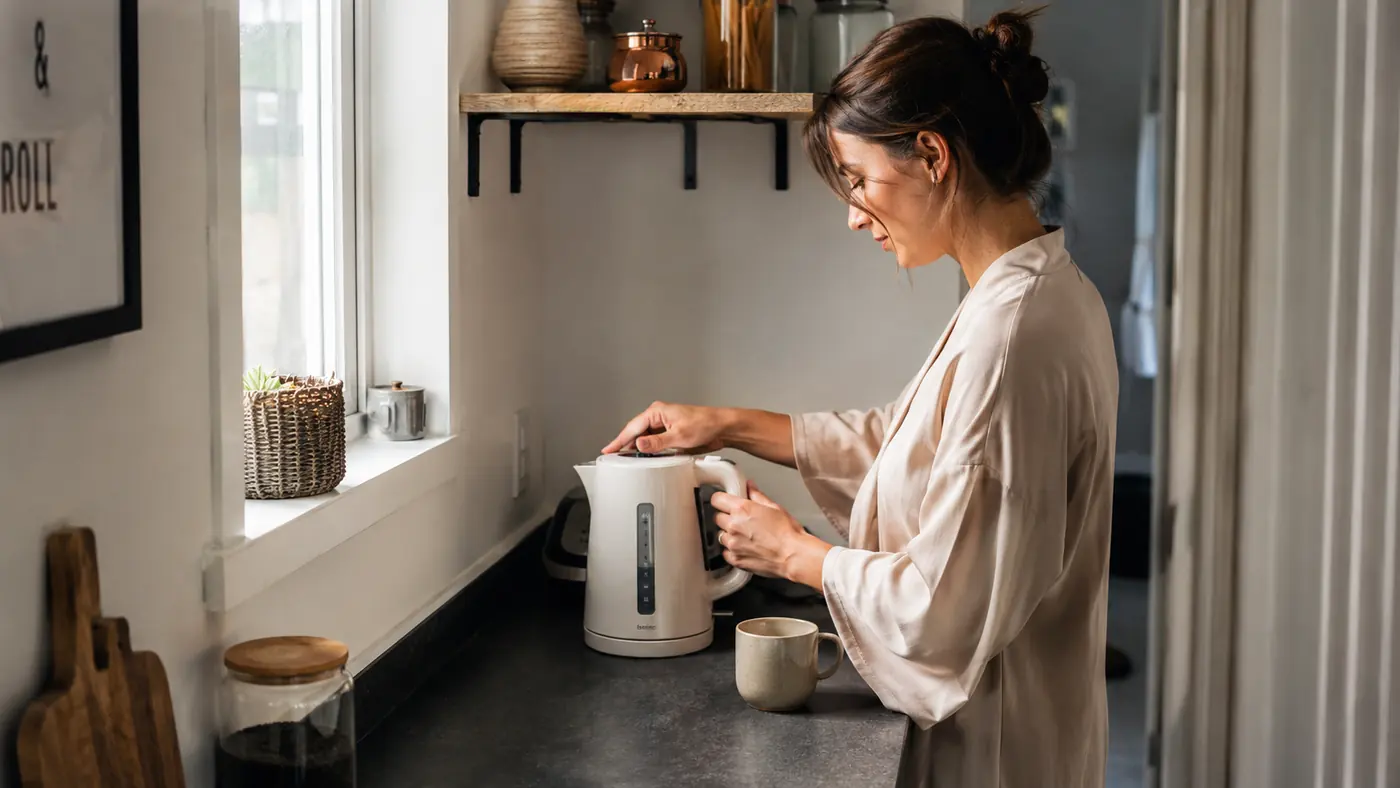
I bought the Hamilton Beach Electric Kettle in January because I was tired of standing at the stove waiting for a pot of water to boil every single morning, and because my old stovetop kettle had started leaving a thin film of rust around the spout that I did not trust anymore. Six months later, it is still plugged into one of my two kitchen outlets, and it gets used at least once a day, usually twice. That's the honest baseline for this review. I'm not writing this after a week of testing it for a photo shoot. I'm writing this after roughly 300 boils, one descaling session I put off longer than I should have, and a morning in April when I nearly knocked it off the counter reaching for coffee before I'd had any.
This is a long-term use review, not a first-impressions post. I already covered the unboxing feel and the first week of use elsewhere, and that's not the useful information if you're trying to decide whether this thing actually holds up in a small kitchen where every outlet and every inch of counter matters. What I want to cover here is what daily life with the Hamilton Beach kettle actually looks like once the novelty wears off, whether the auto shutoff still trips reliably, whether limescale has become a real problem, and whether I still reach for it every morning instead of going back to the stove.
The Quick Verdict
Six months in, this is the appliance I use most without thinking about it. Fast, quiet enough, and it earned a permanent spot on my counter instead of getting shoved into a cabinet.
Amazon Check Today's Price →Still Boiling Water Every Morning After 6 Months, Here's Why It Stuck Around
If you're deciding between waiting on a stovetop kettle and something that actually earns its outlet in a small kitchen, the Hamilton Beach kettle has been the one appliance that never migrated to the back of a cabinet.
Amazon Check Today's Price on Amazon →How I've Actually Used It
My kitchen is a narrow galley with two outlets, and one of them already has the coffee maker plugged into it most mornings, so anything else I buy has to either share that outlet or earn a permanent spot on the other one. The Hamilton Beach kettle holds one liter, which sounded almost too small when I first checked the spec, but in practice it has been the right size for two mugs of tea or one pour-over plus a bit extra, which covers most mornings for me and for my partner Danny when he's staying over. I measured the base before I bought it, because I've made the mistake before of buying something that looked compact online and turned out too wide to sit next to my knife block, and this one sits comfortably in the corner of my counter without crowding anything.
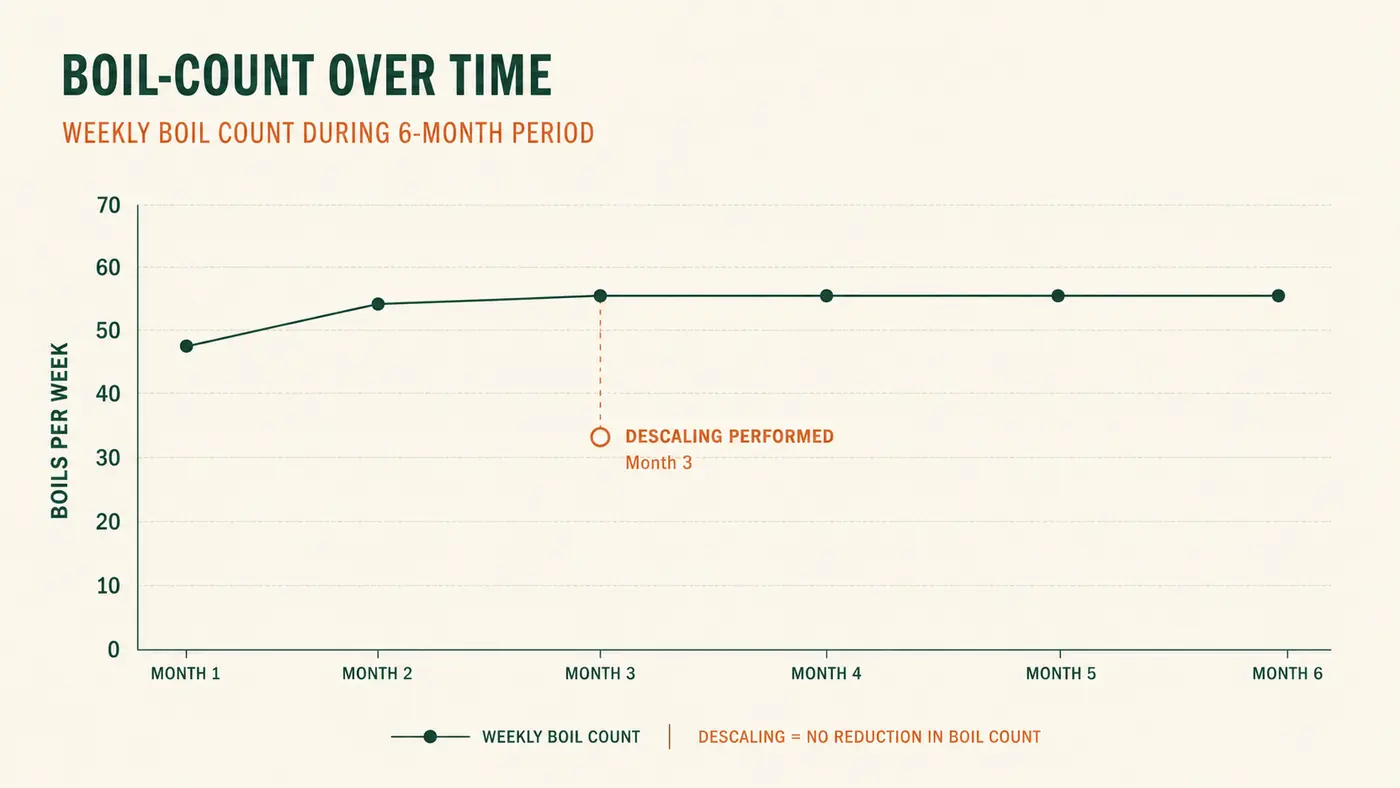
In an average week I boil water with it somewhere between ten and fourteen times. Mornings are the bulk of it: tea for me, instant oatmeal some days, and hot water for Danny's pour-over when he doesn't feel like waiting on the coffee maker. On weekends it comes out again in the evening for hot water bottles when it's cold, and I've used it more than once to quick-boil water for pasta when I didn't want to heat a full pot on the stove for a single serving. It has never once felt like a gadget I forgot about after the first month, which is more than I can say for the rice cooker that's currently living in a box under my bed. If you're weighing capacity and speed against other small-kitchen kettles, I put together a closer side-by-side in Hamilton Beach vs. Cosori for anyone comparing the two before buying.
The interior is stainless steel, and I was curious how that would hold up against the mineral content in our tap water, which is on the harder side in this part of the city. By month three I could see a faint chalky ring near the waterline, the early sign of limescale that anyone with hard water in a small kitchen will recognize immediately. It hasn't affected how the Hamilton Beach kettle boils, but it's the first thing that told me maintenance was going to be part of owning this rather than a one-time setup step.
The Daily Routine, Six Months In
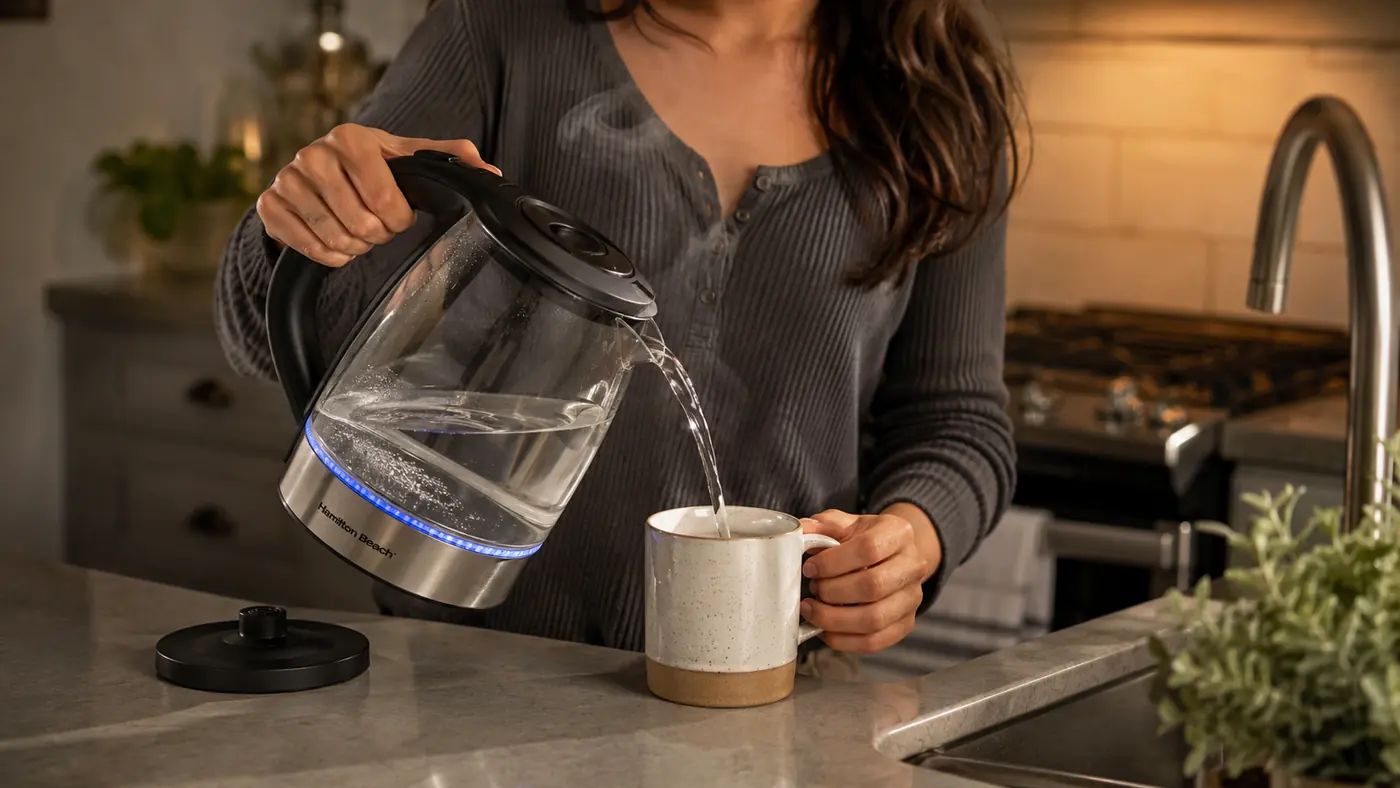
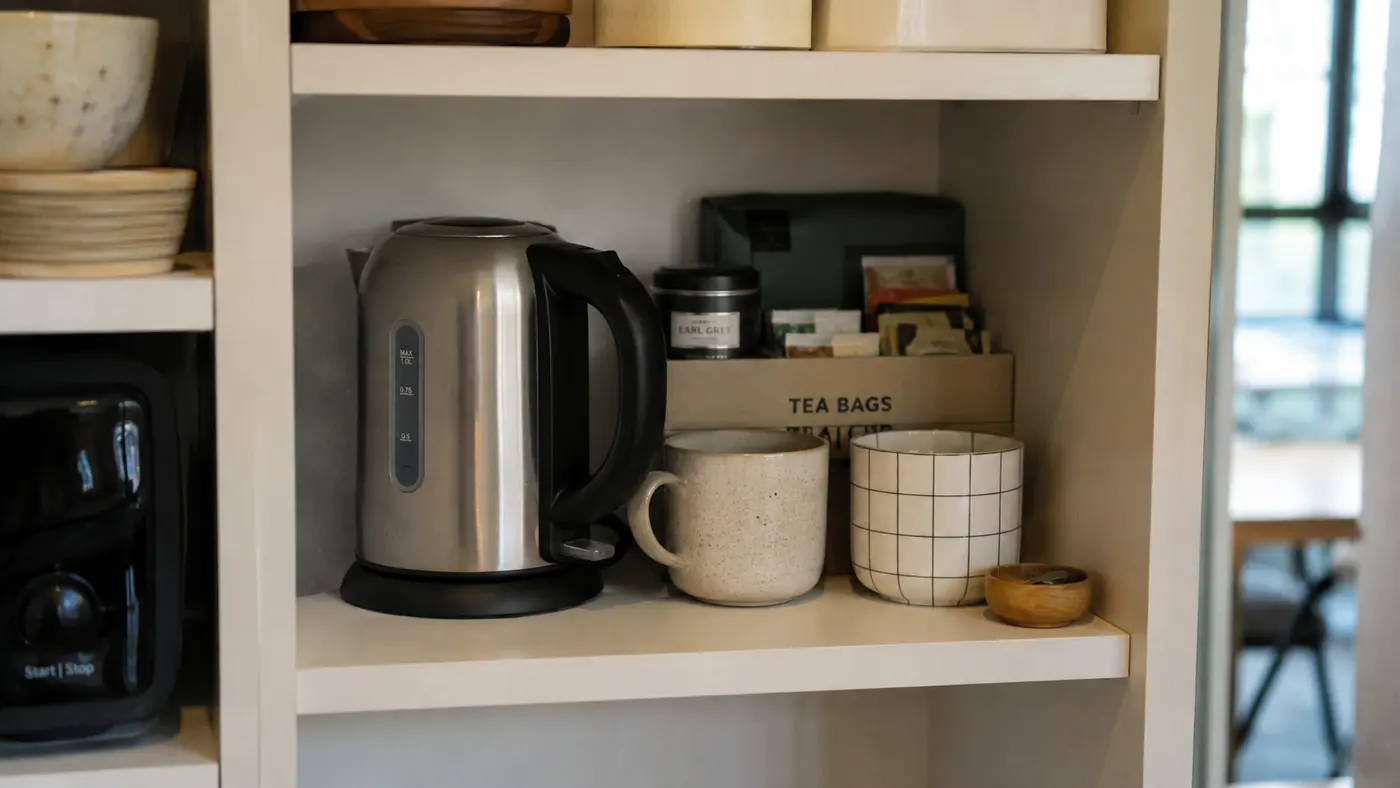
Here's what a typical weekday morning looks like. I fill it at the sink, set it back on the cordless base, and flip the switch while I'm getting the tea bag or the coffee filter ready. By the time I've found a mug, it's already clicked off. The whole unit sits on my counter permanently now, plugged into the second outlet, and I stopped storing it in the cabinet under the sink after about ten days. Early on I tried tucking it away between uses to keep the counter looking clear, and that lasted less than two weeks before the friction of pulling it out every morning made me stop bothering. It lives out now, same as the coffee maker.
The switch is a simple mechanical toggle, no digital display, no temperature presets. Six months of flipping it on every morning hasn't made it feel loose or unreliable, and that matters more than it sounds like it should. I've owned small appliances with digital controls that started glitching within a few months of daily use, and there's something reassuring about a design with fewer parts that can fail. The auto shutoff has never once failed to trip at boil, which matters to me since I've walked away from the kitchen mid-boil more than once while getting dressed.
Limescale and the Filter, Six Months In
This is the part that usually gets skipped in reviews, and it's the part that actually determines whether an electric kettle survives daily use in a small kitchen with hard water. The Hamilton Beach kettle has a small mesh filter at the spout meant to catch mineral flakes before they end up in your cup, and by month two I noticed it was doing exactly that. It's not glamorous, but it works, and I've never poured a cup with visible white flecks in it, which is more than I can say for the stovetop kettle I replaced.
The buildup on the heating element itself is the bigger story. Around month four, boils started taking noticeably longer, maybe an extra thirty seconds, and the bottom had a visible chalky coating when I looked inside. I did a descaling run with equal parts water and white vinegar, let it sit for about twenty minutes, then rinsed it out and boiled plain water twice to clear the smell. That took the boil time back to normal. I now do that roughly once every six to eight weeks instead of waiting for a problem to show up, which has kept the Hamilton Beach kettle running the way it did in January.
What Wore In vs. What Wore Out
Nothing has broken. That's the short version. The cordless base still connects cleanly every time I set the kettle down, no wobble, no loose contact points that make it hesitate before heating. The exterior handle, which felt a little warm to the touch in the first week, has stayed the same temperature through every boil since, so that was never actually a problem, just something I was watching closely early on. The one thing I'll flag is that the lid hinge has loosened slightly with six months of daily opening and closing to refill it, enough that it doesn't always snap shut on the first try, though it has never popped open mid-pour or felt unsafe.
What did change is how I fill it. In the first month I was routinely overfilling it past the max line trying to squeeze out a third mug, and that led to a couple of close calls with water spitting out the spout right as it hit a boil. Once I started filling to just under the marked line, the whole process got quieter and more predictable. That's less a knock on the kettle and more a note for anyone buying their first one: read the max fill line and actually respect it, because I didn't for the first few weeks and paid for it in minor countertop spills.
How It's Held Up Against What I Used to Own
Before this, I used a stovetop whistling kettle that came with my old apartment's leftover kitchen stuff, and boiling water for tea meant standing near the stove for five or six minutes waiting for the whistle. Switching to an electric kettle felt like a small thing on paper, and for the first week I honestly wasn't sure it was worth buying something new for what the stove already technically did. Six months later, the time difference alone has changed my morning routine. A liter of water boils in under five minutes on this thing, closer to three for a partial fill, and I don't have to stand there watching it the way I did with the stovetop version.
If you're weighing whether an electric kettle is worth adding to an already tight kitchen, I wrote a broader breakdown of the case for one in 10 reasons electric kettles save time in small kitchens. The short version from six months of living with this one: for a household of one or two mornings that start rushed, the time saved has mattered more to me than I expected it to when I bought it.
What I Liked
- Still my daily-use appliance six months in, no drop-off in how often I reach for it
- Boils noticeably faster than a stovetop kettle, usually under five minutes for a full liter
- Mesh spout filter has kept mineral flakes out of every cup, even with hard tap water
- Auto shutoff has never once failed to trip at boil across roughly 300 uses
- Compact enough to live permanently on a narrow counter without crowding prep space
Where It Falls Short
- Limescale buildup on the heating element is real with hard water, needs descaling every six to eight weeks
- Lid hinge has loosened slightly with regular use, doesn't always latch on the first try
- One liter capacity means a refill if you're making more than two mugs at once
- No temperature presets, it's a simple boil-and-shutoff design
Who This Has Actually Worked For
This has been the right appliance for someone making tea, instant coffee, or oatmeal for one or two people, in a kitchen where outlet space and counter space are the real constraint, not boiling capacity. If you're regularly making hot water for a whole household or filling a French press for four people at once, one liter is going to mean a refill and a second boil, and that adds friction on a rushed morning. But for my apartment, where the alternative was standing at the stove or giving up counter space to something bigger, the smaller capacity has been the entire point rather than a compromise.
It's also been the right fit for how I actually use hot water day to day, which is mostly tea, pour-over, and the occasional quick-boil for cooking rather than anything more specialized. If your use case is similar, the Hamilton Beach kettle has handled every one of those categories consistently over six months. If you're looking for precise temperature control for specific tea types or pour-over coffee, that's outside what this model offers, since it's a straightforward boil-to-full-temperature design.
The real test of a small-kitchen appliance isn't the first week, it's whether it's still plugged in six months later instead of buried in a cabinet.
Who This Is For
If you're in an apartment, a condo, a dorm, or anywhere with limited counter and outlet space, and you're making hot water for one or two people most days, this has been a reliable daily appliance for me. It's light enough to move if you need the outlet for something else, and small enough that it doesn't dominate a narrow counter the way a full kettle-and-stand coffee setup might. If your main constraint is speed and space rather than sheer volume, six months of consistent use suggests this is a genuinely durable pick, not just a good first impression.
Who Should Skip It
If you're making hot water for a bigger household, or if you regularly need more than a liter at a time without a refill, this is going to feel small fast. I'd also say skip it if you want digital temperature presets for specific brewing methods, since there's none of that here, just a mechanical switch and an auto shutoff, which I've come to appreciate but which won't suit everyone. And if your tap water is genuinely hard, budget for descaling as a recurring chore rather than a one-time task, because that's been the one real maintenance cost of owning the Hamilton Beach kettle over six months.
Six Months Later, Still the First Thing I Plug In Every Morning
If your kitchen has the same outlet and counter problem mine does, this is the one small-kitchen appliance in my apartment that's actually earned its permanent spot next to the coffee maker.
Amazon Check Today's Price on Amazon →