

If your kitchen counter is about three feet of usable space with two outlets that already have to share a coffee maker and a toaster, I'd point you toward the Hamilton Beach 1 Liter Electric Kettle over the bigger Cosori electric kettle, and I want to walk through exactly why instead of just telling you to trust me. I've cooked and made tea in a 500 square foot apartment for twelve years now, narrow galley kitchen, cabinets already packed, and I ran both kettles side by side on my own counter rather than in some open test kitchen with room to spare. The short version is this: the Hamilton Beach wins on footprint, base size, and how often it actually gets reached for on a weeknight when I just want a cup of tea before bed. The Cosori wins when you're making hot water for a full household and have the counter and cabinet space to match.
I want to be upfront that both kettles genuinely boil water fast and do it safely, with auto shutoff and boil-dry protection built into each one. That's not where they differ. Cosori builds a solid electric kettle with a bigger capacity and, on some models, temperature presets that pour-over coffee fans and green tea drinkers actually use. If I only cared about capacity and features for a household of three or four, I'd tell you to look at Cosori first, plainly. But capacity isn't the only question when your kitchen has two outlets and three feet of counter. The real question is what fits next to your coffee maker without unplugging something else, and what you'll actually reach for on a random Tuesday rather than what looks impressive in a photo.
| Spec | Hamilton Beach 1L Kettle | Cosori Electric Kettle |
|---|---|---|
| Capacity | 1 liter, about 4 cups, sized for tea or coffee for one or two people | 1.7 liters, about 7 cups, sized for a full pot or several mugs at once |
| Footprint & base diameter | About 6.7 inches across the base, narrow tapered body that tucks beside a coffee maker | About 7.5 inches across a wider cordless stand that takes up more linear counter space |
| Wattage | 1500 watts | 1500 watts |
| Time to boil at typical fill | About 5 minutes for a full 1 liter fill | About 6 to 7 minutes for a full 1.7 liter fill |
| Temperature control | Single boil setting, no presets, flip the switch and it heats to a full boil | Multiple temperature presets on some models, roughly 175 to 212 degrees Fahrenheit |
| Material & display | Stainless steel body with a plastic handle, simple indicator light | Stainless steel body with a plastic handle and an LED display panel on some models |
| Auto shutoff | Yes, standard boil-dry protection built in | Yes, plus a keep-warm mode on select models |
| Cord storage | Cord wrap built into the base for a shorter counter footprint | Cord wrap built into the base |
Where Hamilton Beach Wins
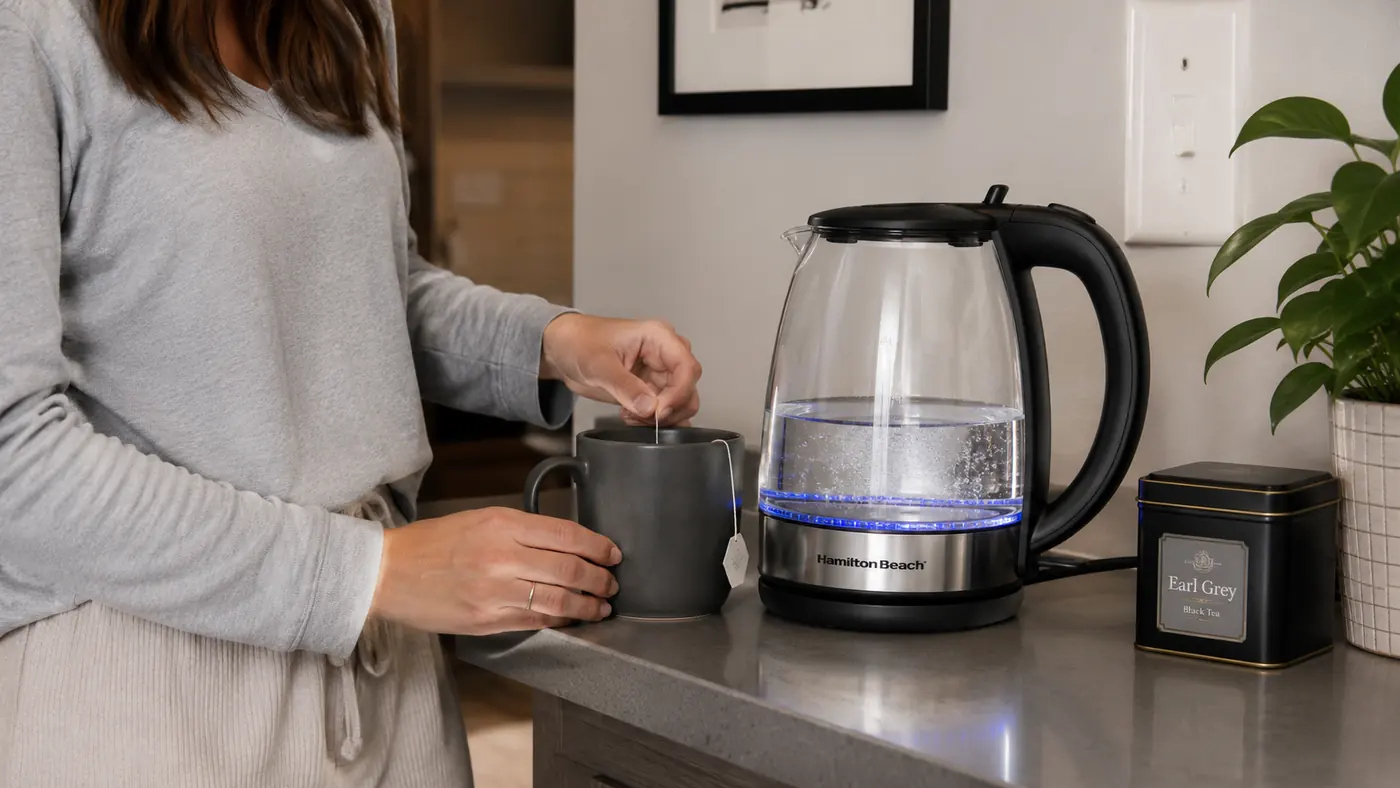
The Hamilton Beach kettle measures small enough that it lives on my counter permanently, tucked right next to the coffee maker, without either one crowding the other or forcing me to unplug something every time I want tea. At 1 liter, it's sized for the way I actually drink tea most days: one mug for me in the morning, sometimes a second for Danny if he's around and wants one too. I'm not boiling water for a dinner party of six in a 500 square foot apartment, and most people in small kitchens aren't either, no matter how big the pitcher on a bigger kettle's box looks. The Hamilton Beach matches the amount I actually use, which means less wasted water sitting in the kettle going lukewarm, and less time standing around waiting on a bigger tank to finish.
It's also narrow enough at the base that it doesn't eat into the sliver of counter I need for a cutting board when I'm making breakfast at the same time. The single boil setting matters more than it sounds like it should. There's no LED panel to navigate at 6:45 in the morning before I've had caffeine, no menu of temperature presets to scroll through when I just want water hot enough for tea. Flip the switch, wait about five minutes, pour. In a small kitchen, on a groggy weekday morning, simple beats feature-rich almost every time, and that's the honest reason the Hamilton Beach gets used daily instead of migrating to a cabinet like a couple of other appliances I've owned and stopped reaching for.
Where Cosori Wins
If you've got a full kitchen and you're regularly making hot water for a household of three or more, the Cosori's bigger 1.7 liter tank is the right call, and I'd rather say that plainly than pretend the smaller kettle is the answer for everyone. That extra capacity means you can fill a full French press and a couple of mugs in one boil instead of running a smaller kettle twice back to back, which matters when everyone in the house wants coffee at the same time on a weekday morning. Boiling twice adds real minutes to a rushed morning, and if that's your household, the Cosori's extra tank size earns its keep.
The temperature presets on Cosori's higher-end models are also genuinely useful if you're particular about water temperature for green tea, pour-over coffee, or French press, where boiling water straight from a kettle can actually scald the grounds or leaves. Some models add a keep-warm mode, which is nice if you're pouring cups over a longer stretch of time rather than all at once. None of that is a knock on Cosori. If capacity and precise temperature control matter more to you than counter space and simplicity, I'd rather point you honestly toward Cosori than talk you into a smaller kettle that won't match how your household actually drinks tea and coffee.
Two Outlets Is Not a Compromise, It's a Constraint
The Hamilton Beach 1 Liter Electric Kettle was built for kitchens like mine, not scaled down from a bigger pitcher kettle. See today's price and current availability before deciding between these two.
Amazon Check Today's Price on Amazon →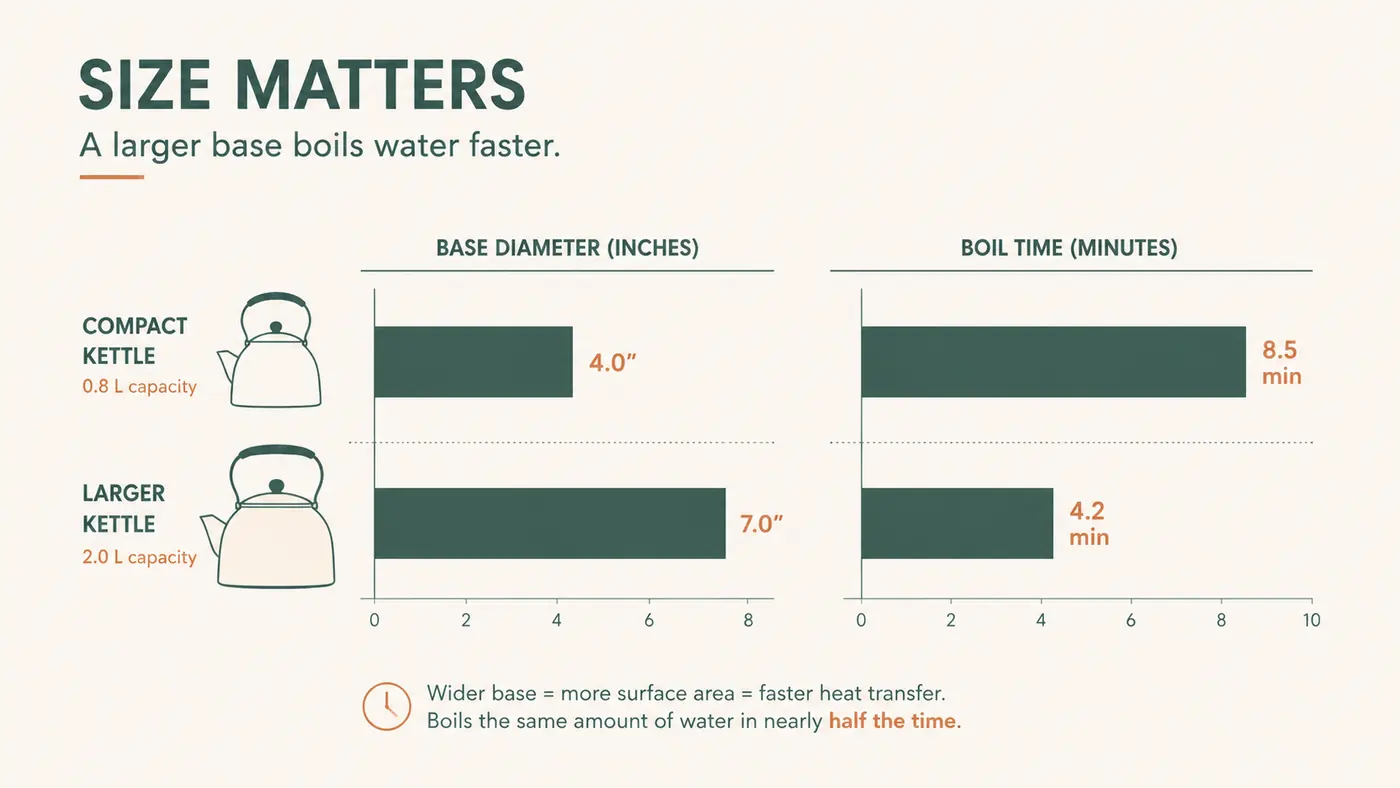
How I Actually Tested Both, Side by Side
I borrowed a Cosori kettle from a friend with a bigger kitchen and ran it on my own counter for two weeks before sending it back, making the exact drinks I'd normally make with the Hamilton Beach: morning tea, the occasional pour-over, hot water for oatmeal on a cold week. I wasn't comparing spec sheets, I was comparing how each one behaved in the actual footprint I have to work with. The Cosori boiled reliably and the temperature presets were a nice touch for pour-over mornings, no complaints on performance. But every single time I used it, its wider base meant sliding the coffee maker over a few inches first, and every time I finished, I had to decide whether to leave the bigger kettle out or find room for it, because it didn't fit in the spot I'd already cleared for the Hamilton Beach.
That friction is the whole story in a way a spec sheet never captures. It's not that the Cosori made worse tea, it's that using it added a small shuffle to every morning that the Hamilton Beach doesn't add. Two weeks in, I caught myself reaching for the smaller kettle out of habit even on the mornings I meant to test the Cosori, just to avoid moving the coffee maker again. That's the pattern I hear about most from readers in small kitchens: the bigger appliance gets used for the first week out of novelty, then quietly stops getting pulled to the front of the counter because it's a hassle to make room for every time. A kettle that boils a little less water but actually gets reached for beats a bigger one that ends up pushed to the back.
Everyday Value: The Stuff Spec Sheets Skip
Spec sheets don't tell you how a kettle actually behaves after six months of daily fills at the sink, and they don't tell you how much of your two outlets you're willing to give up permanently to one appliance. The Hamilton Beach's narrower base means it sits flush against the backsplash without blocking the second outlet, so I can still plug in the toaster without unplugging the kettle first. The Cosori's wider cordless stand needed more clearance around it, and on my counter that meant it either blocked the second outlet or had to sit at an angle, neither of which felt like a permanent solution in a kitchen this tight.
Everyday value also comes down to how often something actually gets used relative to what it cost. The Hamilton Beach's current price sits well below what you'd pay for a Cosori model with the LED display and presets, and for my household of essentially two people, I never once wished I'd paid more for temperature presets I wasn't going to use consistently. If you're the kind of tea drinker who genuinely cares about hitting 175 degrees for green tea every single time, that math changes, and paying more for Cosori's presets is a reasonable trade. For everyone else boiling water for tea, oatmeal, or a quick pour-over, the Hamilton Beach does the actual job without asking you to pay for features that sit unused.
The Hamilton Beach matches the amount of water I actually boil, and a kettle you'll reach for every morning beats a bigger one taking up a second outlet you need for something else.
Apartments, Dorms, and RVs: Where This Comparison Actually Matters
This comparison isn't really Hamilton Beach versus Cosori in the abstract. It's about matching a kettle to the kitchen and the outlets you actually have. In a dorm room with one shared outlet strip, a wider Cosori base can crowd out a mini fridge or a hot plate that also needs power, leaving nowhere to actually set the kettle down between uses. In an RV, where every appliance has to earn its cabinet space and weight matters when you're driving, the Hamilton Beach's smaller footprint and lighter build make it something you can stow without it rattling around a shelf. I hear from readers in all three situations, apartments, dorms, and RVs, and the complaint about oversized kettles is always the same: it looked fine in the store, then it got home and there was nowhere for it to actually live next to the other things that need power.
That's the gap between a spec sheet and a real kitchen. A bigger tank looks like a better deal on paper, more capacity, more presets, a nicer display. But if it blocks your second outlet, crowds your coffee maker, and holds more water than you'll drink before it goes cold, that capacity goes unused. I'd rather boil a smaller amount of water daily in the Hamilton Beach than own a bigger kettle that ends up pushed to the back of the counter after a month. That's the honest math behind why I recommend the Hamilton Beach for the specific readers this site is built for.
Who Should Buy Which
If you're making tea or hot water in a studio, a one-bedroom, a dorm, or an RV, and you're pouring for one or two people on most mornings, get the Hamilton Beach 1 Liter Electric Kettle. It's sized for your counter, your outlets, and your actual mug count, not for a household you don't have and don't need to plan for. If you've got a full-size kitchen with room to spare and you're regularly boiling water for three or more people, or you genuinely use temperature presets for pour-over and green tea, Cosori's bigger tank and display will earn its keep in that household. I've put together a full breakdown of what six months of daily use with this exact Hamilton Beach kettle actually looks like in my long-term review, and an unfiltered look at the pros and cons in my honest review, if you want more detail before you decide.
Still Deciding? Start With the Kettle That Fits Your Counter
The Hamilton Beach 1 Liter Electric Kettle is sized for small kitchens, not scaled down from a bigger pitcher kettle. Check today's price and current availability on Amazon.
Amazon See Current Price on Amazon →